Friday, May 6, 2016

WSS to co-ordinate bunker calls

Wilhelmsen Ships Service logotype


Ship operators who rely on a myriad of companies for their global bunkering needs are wasting time, money and energy, Wilhelmsen Ships Service (WSS) claimed.
 
With no guarantee of standardised quality of products and services in an industry defined by tight margins and cost constraints, this approach is ultimately bad for business, WSS said.

WSS is now offering an alternative- bunker service agreements. These are claimed to provide shipping companies with peace of mind and uniform quality, as WSS’ global agents lead the process for the customer, to help ensure efficient communication, minimised administration and high standards. Everything is streamlined - with predictable pricing for a clear set of deliverables with no hidden extra fees.

WSS estimated that there are over 80,000 bunker-only port calls each year. Although these are relatively simple operational tasks, they come with a complex web of administrative and qualitative considerations, as highlighted by Daniel Wikstroem, Business Manager, Ships Agency, WSS, who said;“Bunker-only calls can be a real headache for ship operators used to high quality, efficiency and performance driven day-to-day operations.”

“Typical bunker calls include up to 40 lines of communication, between an array of parties – including port agents, bunker brokers and bunker surveyors – up to two separate financial transactions, and an excessive administrative workload checking disbursement accounts. Multiply this on a global level, on a port-by-port basis, and there is huge room for unpredictability – in terms of the complex delivery chain – and a massive man-hour inefficiency. And it goes without saying that time is money.

“Shipping firms will rely on their bunker brokers, or procurement departments, to select the right fuel supplier, but what information can they themselves access with regards to typical bunkering times? Reliability? Punctuality? Ease of use? These factors make a real difference between a seamless bunkering process and a convoluted, lengthy and therefore costly one. There’s an opaque area here where it’s very easy to lose time and money,”he explained.

With this in mind, WSS is advising ship operators to adopt a ‘one stop shop’ strategy. The Oslo-headquartered business, which undertook over 4,000 bunker-only calls, at over 150 ports, last year, uses its global network to offer Bunker Service Agreements.

A uniform global bunkering routine ensures that each call runs smoothly, with, amongst other things: pre-arrival formalities and ISPS requirements completed 24 hours prior to arrival; bunker suppliers, surveyors, port authorities and pilots always given vessel ETA updates; service boats always ready for bunkering surveyors upon arrival, and completion; and a strict following up of all bunkering progress, WSS claimed.

Wikstroem said that by switching to the WSS bunkering solution, a typical client performing around 100 annual bunker calls, would save over $20,000 per year through reduced bank transactions and paperless disbursement accounts handling alone.

In addition, WSS’ worldwide operation allows it to accumulate detailed performance records of suppliers, giving it, and its customers, an intimate barge-side knowledge of all bunker operations in all major bunker ports.

“Our completely independent, expert insight can cut through any potential uncertainty relating to suppliers and lead to enhanced decision making… and efficiency,” Wikstroem said.

Thursday, May 5, 2016

VLCC chartering activity reaches one-month highs with Middle Eastern fixtures rising by 93% on the week


The VLCC market is on a roll over the course of the past few weeks. In its latest weekly report, shipbroker Charles R. Weber said that “the pace of VLCC chartering was at a one‐month high this week as charterers were busier following last week’s lull. A total of 27 fixtures were reported in the Middle East market (+93% w/w) and seven were reported in the West Africa market (+75%, w/w). Notably, all of this week’s West Africa fixtures were covered on units ballasting from Asia, but despite the corresponding strong level of draws on Middle East availability, rates corrected sharply over the course of the week with the benchmark AG‐FEAST assessment setting a fresh YTD low of ws46 towards the close of the week (which also represents significant erosion from the ws92.5 at which the route commenced April)”, said the shipbroker.

According to C.R. Weber “one factor behind this week’s rate slump is that much of the Middle East market’s inquiry was oriented to the start and the end of the week, leaving a much quieter mid‐week period which negatively impacted sentiment. Another factor behind this week’s rate losses was the fact that charterers were covering nearer forward dates which alleviated some of the uncertainty inherent to normal forward windows amid ongoing operational delays in Asia; as the pool of units in play were already largely undertaking ballasts all were able to be seriously considered for fresh requirements. For their part, supply/demand fundamentals continued to disjoint. We note that with 60 May cargoes covered to date, we anticipate only up to 5 additional cargoes remain uncovered. Against this we note that there are 19 vessels available and even if assuming that draws to service West Africa cargoes remain steady from this week’s level, the implied surplus at mid‐May is 8 units in a low case. Through the end of the second decade of May’s loading program that surplus could rise to 15 (excluding any hidden positions). Given the extent of this week’s rate losses and the fact that while availability levels have expanded they remain manageable at present rates, we expect that rates will stabilize during the upcoming week”.

Middle East

“Rates on the AG‐FEAST route dropped 12 points over the course of the week to a closing assessment of ws48. Corresponding TCE fell 32% to ~$30,134/day. Rates to the USG via the Cape were off by 5.5 points to a closing assessment of ws33.5. Triangulated Westbound trade earnings declined by 10% to ~$59,690/day at present”, said CR Weber. Similarly, in the Atlantic Basin, “rates in the West Africa market continued to follow the direction of those in the Middle East. The WAFR‐FEAST route concluded the week at ws56, off 6.5 points from a week ago. Corresponding TCEs observed a weekly loss of 17% at a closing assessment of ~$40,813/day. The Caribbean market remained slow with the CBS‐ SPORE route holding at the $5.25m level”.

Suezmax

“Chartering activity levels in the West Africa market were largely unchanged this week with a total of 12 fixtures representing a weekly increase of one. Charterers have moved slowly past May’s first decade loading period which has kept stronger activity levels at bay for now but; simultaneously, low VLCC coverage of the month’s program thus far leaves more cargo available to Suezmaxes which should drive demand in the coming weeks. The recognition of this fact has seen owners more resistant to lower rates and the WAFR‐UKC route was steady at ws82.5 while the WAFR‐USAC route eased by a modest 2.5 points on recent strength in the Caribbean likely to maintain limited slower demand levels for the larger tanker which in the coming weeks should see realized Suezmax demand strength. Between potential imminent demand strength and the probability that such will remain when charterers progress into June, rates are likely to remain steady early during the upcoming week with possibly firming thereafter”, said CR Weber.

Aframax

According to the shipbroker, “the Caribbean Aframax market commenced the week with strong rate gains after surprisingly demand materialized late last week with positive sentiment extending to the start of this week. However, as the week progressed the upward trend subsided once market participants realized that some units reportedly on subjects were either erroneous or had failed, leaving a less tight fundamentals profile. Having reached ws145 on Monday, the CBS‐USG route moderated to the low ws140s at which it remained through the remainder of the week. Sentiment concludes the week slightly soft due to a late‐week demand lull; however, with supply/demand balanced relative to present rates we expect that ws140 will represent a floor early during the start of the upcoming week with no major impetus for positive or negative progression presently evident”.

Panamax

Finally, “the Caribbean Panamax market was markedly more active this week with a surge of regional fixtures appearing early during the week while some swaps and stronger Aframax rates added to the pressure. As a result, the CBS‐USG routed observed a weekly gain of 15 points to a closing assessment of ws120. Failing a fresh demand surge early during the upcoming week, supply/demand fundamentals appear balanced though some units incoming from the Med and a less hectic pace could see rates moderate from the present high”, said CR Weber.
Nikos Roussanoglou, Hellenic Shipping News Worldwide

Wednesday, May 4, 2016

Rare Biodiesel Import to the U.S. from Australia Detected

biodiesel imports from Australia


On April 27, 2016, Genscape Vesseltracker detected a shipment of 4,200 tons (about 1.3 million gallons) of biodiesel from Australia arriving at the Texas Terminals Wharf in the Houston area. The Stolt Sun vessel carried the product that originated from the ports of Adelaide and Fremantle in Australia.

According to data from the EIA, the U.S. hasn’t seen imports of biodiesel from Australia since January 2013, and the shipments from Australia have only occasionally occurred in the EIA’s recorded history (February 2012 and May 2011). 

What is interesting about Australian biodiesel imports?

According to the 2015 USDA FAS GAIN report, Australia only produced about 17 million gallons of biodiesel in 2014. When the report was issued in August 2015, the expectation was that there would be 26 million gallons produced in 2015. The USDA also reported that only four of the eight biodiesel plants in Australia were operating at that time.

Genscape Vesseltracker tracking of an Australian biodiesel import to the U.S.
Genscape Vesseltracker tracking of an Australian biodiesel import to the U.S. Click to enlarge
 
U.S. imports would suggest little Australian demand for biodiesel and favorable economics stateside with the current regulatory incentives, even with the nearly two-month journey.

What are the potential implications?

The Blender’s Tax Credit, increased Renewable Fuel Standard volumes, and the value of Low Carbon Fuel Standard credits are driving increased U.S. consumption of biodiesel in 2016. A big question for the industry is how much of that will come from non-U.S. versus U.S. sources. Seeing another source of imports that wasn’t in the market in 2014 and 2015 could be an indication of the strength of imports in fulfilling increased demand.

Using Genscape Vesseltracker AIS data and proprietary ship tracking, the Global Biodiesel Monitor provides stakeholders with access to key international shipment information to deliver a more complete picture of biodiesel and renewable diesel flows worldwide. To be in the know about U.S. imports of biodiesel and renewable diesel in this pivotal year for advanced biofuels, contact Genscape for a free trial to the Global Biodiesel Imports Monitor. With your trial subscription, you will discover the consignee that received the Australian shipments and all other biodiesel and renewable diesel imports. Click here to learn more or request your free trial now.

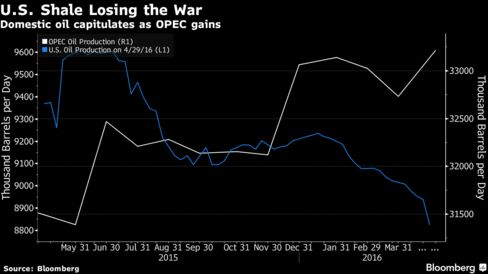
U.S. Output Tumbles as Shale Drillers Capitulate to OPEC. Chart


The U.S. shale industry is finally surrendering in the oil supply war. U.S. production has declined 5.8 percent in the past year as the Organization of Petroleum Exporting Countries continues to boost output. Domestic production tumbled 113,000 barrels a day last week to 8.825 million barrels, the lowest since September 2014, the Energy Information Administration said Wednesday.

Ghana’s Tema Oil Refinery makes profit in 7 years

 APA


The Tema Oil Refinery (TOR) of Ghana has bounced back into operation announcing $800,000 profit between February 16, 2016 and April 20,2016, local media reports said on Tuesday.The feat comes after seven (7) years of inactivity and inability to make profit by the state oil refinery, forcing government to encourage the importation of refined petroleum products into the country.

The Daily Graphic published on Tuesday that the success story of TOR was resonated at the May Day parade in Wa on Sunday, where it was made evident that a collaboration between labour, management and and government has turned the only state refinery in the country round.

Before the success, TOR was marked by debts and inconsistencies, forcing government to impose TOR recovery debts on petroleum products, thereby bringing untold hardships to Ghanaian fuel consumers.

The paper said as a result of the success, a thanksgiving service has been held where the Acting Managing Director of TOR, Mr. Kingsley Awuah-Darko, assuring that the company has been given a sound footing to operate now for profits.

Monday, May 2, 2016

Jubilee Turret Issues Continue

tullow


Tullow Oil, in its AGM Trading Update revealed that the technical investigation of the Jubilee FPSO turret bearing has confirmed that it is no longer able to rotate as originally designed leading to new operating procedures being implemented.

The procedures being investigated include the vessel being put on “heading control” which requires the use of tugs to minimize vessel rotation and revised offtake procedures, including the use of a dynamically positioned shuttle tanker and a storage tanker. Revised operating procedures are being implemented at the Jubilee field with new equipment and approvals in place.

Tullow said that sea water injection resumed on April 23 and offtake is expected to re-commence in the next few days with production to follow shortly thereafter. These activities and the two-week planned maintenance shutdown have impacted gross production from the Jubilee field which averaged 80,300 bpd (gross), for Q1.

A project team has been established to review the root cause of the problem and determine the optimum design of the permanent solution of the Jubilee turret issue. A decision on the solution is expected in the next few months.

On the financial end, Tullow has a comprehensive package of insurances in place including Hull and Machinery insurance, procured on behalf of the JV which covers relevant operating and capital costs associated with damage to the FPSO, and Business Interruption insurance which covers consequent loss of production and revenue. Claims under both policies have been notified to our insurers.