Thursday, August 31, 2023

Wednesday, August 30, 2023
Amazon CEO Andy Jassy warns remote workers: ‘It’s probably not going to work out for you’

Amazon CEO Andy Jassy told company employees who defy his edict to return to the office for at least three days a week that “it’s probably not going to work out for you.”
Jassy made the comments during a meeting earlier this month during which he expressed frustration over the fact that some employees were not taking the return-to-office mandate seriously, according to the news site Insider , which obtained a recording of the CEO’s comments.
During the meeting, which is known in internal Amazon lingo as a “fishbowl” meeting, Jassy declined to share data that motivated his decision to require employees to return to the office.
The CEO told his charges it was a “judgment” call.
Employees who were unhappy with the decision were invited to seek employment elsewhere, Jassy reportedly said.
“It’s past the time to disagree and commit,” he said.
“And if you can’t disagree and commit, I also understand that, but it’s probably not going to work out for you at Amazon because we are going back to the office at least three days a week, and it’s not right for all of our teammates to be in three days a week and for people to refuse to do so,” the 55-year-old Jassy said.

Jassy told his employees that he spoke to scores of other CEOs and that “virtually all of them” preferred having their employees back in the office.
Last month, Amazon confirmed that it was asking some corporate workers to relocate to other cities as part of its return-to-office policy.
Amazon employees who refused to relocate near the main offices of their teams were told they either had to find a new job internally or leave the company through a “voluntary resignation.”

In March, around 30,000 workers signed a petition begging Jassy to cancel his directive that most employees work on-site at least three days per week.
The return-to-office plan took effect on May 1.
In February, Jassy said the company made its decision to bring workers back after observing what worked during the pandemic.

Among other things, he said the senior leadership team watched how staff performed and talked to leaders at other companies.
He said they concluded employees tended to be more engaged in person and collaborate more easily.
Earlier this year, Amazon, which employs more than 1.5 million people worldwide, announced it was laying off 27,000 workers as part of a broad cost-cutting push.
Recent Mask Mandates Lifted Amid Pushback
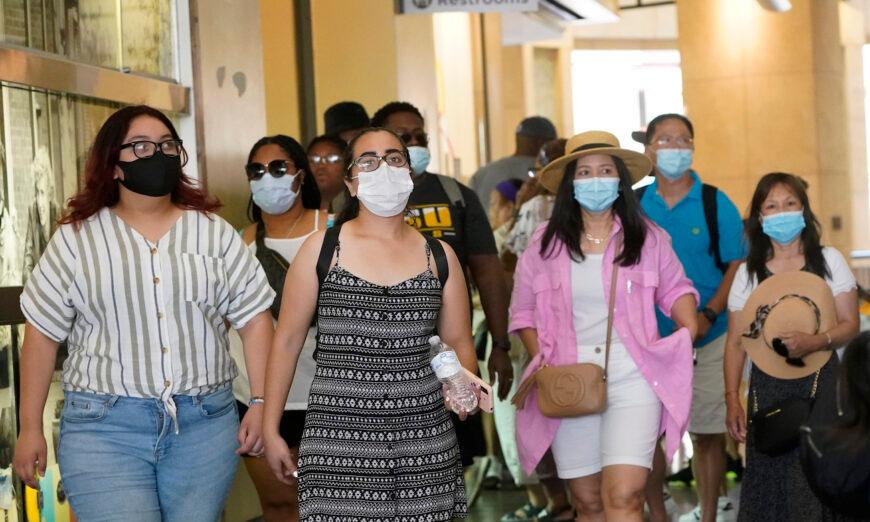
People wear masks as they walk in a shopping district in the Hollywood
section of Los Angeles on July 1, 2021. (Marcio Jose Sanchez/AP Photo)
https://www.theepochtimes.com/us/recent-mask-mandates-lifted-amid-pushback-5481484
Kaiser Permanente in Santa Rosa, California, on Aug. 24 reversed a recent policy that would require masks in its hospital after it reinstated the mandate days before. A Hollywood studio also said it would do away with its mandate.
Officials for the hospital system told the Santa Rosa Press Democrat that the mask policy applies only to staff, not patients. It said that it is “strongly encouraging masks for patients, members, and visitors in the hospital and medical offices in the Santa Rosa Service Area in response to this latest increase in COVID-19 cases.”
“Our intent was to communicate that as of Tuesday, we have expanded the masking requirement for our employees and physicians to medical offices and clinic settings; we apologize for any confusion among Press Democrat readers,” Kaiser said in its latest statement.


The statement also said that "visitors, patients, and members are strongly encouraged to also wear masks in these settings,” according to the paper. “We have not changed our masking requirements in the hospital, which have been in effect since April: employees and physicians are required to wear masks and we ask visitors to wear masks when in the hospital.”
It doesn't appear that Kaiser Permanente, which operates hospitals across the United States and California, would also attempt to reinstate mask mandates at other locations.
Days before its latest statement, the hospital system said it would be mandating masks for patients, doctors, patients, visitors, and staff members at its hospital and medical offices.
“Kaiser Permanente Northern California is committed to protecting the safety of our members, patients, employees, physicians, and visitors, which includes taking appropriate steps to prevent the spread of transmissible infectious diseases in our facilities," it told local media.
Some Northern California locals weren't happy with the announcement that mask mandates would return, according to local outlets.
"They told us a bunch of [expletive]," Richard Staudinger, a North Sacramento resident, told CBS. "I think most of the people don't believe it now."
Another, Craig Roberts, said, "I think it's more political than anything, just think they're trying to do what they did in 2020."
But some said they don't mind the mandates. "I don't have a problem if they reinstate the masks," Kiona Cooper, of Northern California, said.
Other Mandates
Meanwhile, the Lionsgate film studio in Santa Monica also said it would not be implementing a mask mandate, days after the media company said it would force workers to put on masks again on certain floors. It claimed that it never changed its mask policy.
“The LA County Department of Public Health notified us yesterday that we could lift the mask requirements, effective immediately, and we have," the firm told news outlets over the weekend.
The statement also said: "Lionsgate never changed its own mask policy. The LA County Department of Health ordered us to institute the temporary masking requirement after we reported a cluster of COVID cases to them and we have an obligation to comply with their orders."
Last week, a Lionsgate memo stated that employees on only certain floors have to wear surgical masks, KN95 masks, or N95 masks "except when alone in an office with the door closed, actively eating, actively drinking at their desk or workstation, or if they are the only individual present in a large open workspace.”
Earlier in the month, data from the Centers for Disease Control and Prevention showed that COVID-19 hospitalizations rose across the country. Hospitalizations rose by 21.6 percent, to 12,612 new admissions from 10,370, according to the data ending Aug. 12.
Despite the increase, it’s among the lowest levels of hospitalization recorded since the start of the pandemic in early 2020.
“An upswing is not a surge; it’s not even a wave,” Dr. Shira Doron, the chief infection control officer for Tufts Medicine, told ABC News. “What we’re seeing is a very gradual and small upward trajectory of cases and hospitalizations, without deaths really going along, which is great news.”
At the same time, several hospitals, including some in upstate New York, and Morris Brown College in Atlanta reimplemented mask mandates, prompting concerns about a broader effort to force masks on people, three years after the start of the pandemic in the United States. Media coverage around the small increase in COVID-19 cases has also focused on whether masks should be worn, with mainstream outlets such as CNN interviewing doctors who say people should start wearing them again.
But some politicians and commentators, in response, called on supporters to resist the mandates.
“It’s alarming that the mandates are kicking in again,” Sen. Ron Johnson (R-Wis.) said in a recent interview. “It’s like, OK, we noticed masks didn’t work, particularly for children. We always knew they didn’t work for kids.”
It also comes as President Joe Biden on Aug. 25 told reporters in Lake Tahoe that he signed off on a proposal "to present to Congress a request for additional funding for a new vaccine that is necessary, that works."
Column: Copper trapped between old and new supercycles

https://www.mining.com/web/column-copper-trapped-between-old-and-new-supercycles/
Copper may be poised to embark on a new energy transition supercycle but it is currently struggling to escape the gravitational pull of the old Chinese supercycle.

China has been the core driver of copper pricing over the last two decades as the country built new cities and rolled out the infrastructure needed to power them.
Booming domestic demand for industrial metals was coupled with rising exports of manufactured products as China became the world’s workshop.
The twin engines of China’s previous spectacular growth are now stuttering as a property bubble deflates at home and high inflation weakens demand for its products abroad.
The London Metal Exchange (LME) three-month copper price has been oscillating in a $7,800-8,870 per metric ton range since May as old and new price drivers compete.
Fund positioning on both the LME and the CME is equally caught between a waning China-centric supercycle and the nascent green supercycle.

Chop and churn
Money managers flipped back to net short of the CME copper contract at the start of this month in a continuation of the positioning chop that has characterized the market since March.
The gyration in net positioning is partly a reflection of copper’s own choppy range-trading with many black box funds configured to react to changes in directional momentum.
It is also down to the ebb and flow of the Chinese recovery narrative.
Early-year optimism that the country would rebound strongly from last year’s zero-Covid restrictions was dispelled by the end of the first quarter.
Since when copper and the rest of the industrial metals pack have been trading the prospect of renewed stimulus by Beijing policymakers.
Support measures have so far failed to match bullish expectations even as the rumblings from a distressed property sector grow ever louder.
Money managers have lifted outright short positions on CME copper to 69,707 contracts, the largest collective bear bet on lower prices since early 2020.
Long positions slipped to 51,580 contracts over the week to Aug. 15 but only after hitting a six-month peak of 63,957 the previous week.
The net short position of 18,127 contracts is a sign the bears are in the ascendancy.

Bullish and bearish
In London it’s the bulls who have the upper hand, investment funds net long of the London copper market to the tune of 14,143 contracts as of the close of Aug. 11.
However, there is equal confusion as to copper’s next major directional move with money managers ramping up both bullish and bearish bets.
Outright short positions held by investment funds reached 47,541 contracts on Aug. 11, the heaviest bear commitment since the LME first started publishing its Commitments of Trading Report in 2018.
However, bullish bets also hit a fresh high of 67,583 contracts the week earlier before easing back to 61,724 in the last reported week.
Fund managers of different complexions have been simultaneously peak bullish and peak bearish over the first part of the month.
“Other financial” players, which includes index operators and insurance companies, are caught somewhere in the middle, holding a marginal net long position of 3,911 contracts.
Waiting for lift-off or breakdown?
The key takeaway from speculative positioning on both US and London markets is that fund players are betting bigger on copper.
The recent accumulation of both short and long positions suggests funds are positioning themselves ahead of some sort of break-out from the recent trading range.
It’s just that there is no consensus as to whether the copper price will break upwards or downwards.
Which is more important? Old cycle or new cycle?
China’s property woes are piling up with developer Country Garden in financial difficulty and missed payments on investment products by Zhongrong International Trust Co highlighting the risk of contagion to China’s $3 trillion shadow banking sector.
The bullish counterpoint comes in the form of rising copper usage in energy transition applications as both the United States and Europe turbocharge electric vehicle sales and the renewable energy network needed to support the pivot away from fossil fuels.
Doctor Copper appears undecided as to which supercycle is currently strongest.
Fund managers are too.
(The opinions expressed here are those of the author, Andy Home, a columnist for Reuters.)
(Editing by David Evans)
Nearly 250 kids from asylum-seeking families set to start school in four upstate counties

Roughly 250 children from asylum-seeking families are set to start school next week in four upstate counties where New York City has placed them through contentious resettlement efforts.
The children are entitled by law to a public education, regardless of their immigration status. Their transfers from the city to other parts of New York over the last few months has passed the notable responsibility of schooling to the communities where they now live, even as the city continues to pay for their hotel lodging, food and other costs.
The new students are enrolled in Schenectady, Erie, Albany and Monroe counties. Their school districts are getting no immediate funding from either the state or New York City to hire more teachers or aides, if needed, although they may later recoup at least part of those costs.
The incoming students are a small fraction of the 14,000 kids from asylum-seeking families who reportedly were enrolled in New York City schools as of April. The city, which currently has around 59,000 asylum seekers in its care, has taken in more than 100,000 in all since Texas and Arizona began busing them to New York from the southern border in the spring of 2022.
Which upstate schools are they attending?
Perhaps the biggest influx will be in Mohonasen School District, a 2,700-student system in Schenectady County that is expecting 70 students from families living at a Super 8 motel in Rotterdam.
Shannon Shine, Mohonasen's superintendent, told the USA Today Network this week he estimates his district will pay at least $300,000 in additional personnel costs. It's hiring two more English language teachers, two teaching assistants and a part-time social worker to accommodate the new students, most of whom speak Spanish.
Incoming students:How NY schools will handle student influx as 'large numbers' of asylum seekers arrive
The other new enrollments of migrant children from the city, based on USA Today Network reporting and published accounts, include about 120 students in three Erie County districts; 39 in North Colonie School District in Albany County; and 18 in City of Rochester schools.
Three of seven counties where asylum seekers were placed have no school-age children among them. The 272 migrants bused to hotels in Orange and Dutchess counties in May were all men who came to the U.S. without kids. And the roughly 400 migrants housed in three Westchester County hotels include no kids ages 5 and older — at the insistence of local officials.
"We've been very clear to the City of New York that it is unwise to have school-age kids here in the suburbs," Westchester County Executive George Latimer said Monday during a weekly video address.
Latimer argued Westchester was less suitable for migrant students than New York City because it has multiple school districts with varying capacities and different funding means than the city's school system. Another contrast, he said, was that the city's schools are controlled by the mayor, while he has no control over Westchester schools.
With the reopening of schools approaching, State Attorney General Letitia James and Education Commissioner Betty Rosa issued a strongly worded reminder this week about the legal rights to public education for any children ages 5 to 21.
"This right is firmly embedded in our Constitution, federal and state laws, and the regulations that govern our state’s public schools," they wrote.
How does the funding work?
State education officials said this month the state could offer various forms of assistance but no emergency funding for districts enrolling migrant students from New York City. Its help could include "technical assistance, training, classroom tools, and professional development" to teach English learners.
Gov. Kathy Hochul also pointed out that districts got big increases this year in foundation aid — their main source of state funding — that could help them absorb unforeseen costs.
That is borne out in aid figures for districts where asylum-seeker students enrolled. Mohonasen School District's funding jumped by $4.7 million, or $27%. North Colonie's leaped by $7.9 million, or 37%. Maryvale School District, an Erie County school district with 66 new migrant children enrolled, got an increase of $4.6 million, or 31%.
Shine, the Mohonasen superintendent, told the USA Today Network his district should get reimbursed at least partially next year through foundation aid for its increased enrollment. But he said he didn't know yet if it would fully recover the roughly $300,000 in estimated additional costs.
Districts also could apply to the state for tuition reimbursement for educating homeless children from another district. If approved, the state could then charge New York City a "basic contribution" for that expense if it's deemed the "district of origin," said Keshia Clukey, a state Education Department spokeswoman.
"The Department is examining all funding streams and appropriate funding mechanisms with our partners in federal and state government to ensure districts have the resources they need to provide all students equitable access to a high quality education," Clukey said in an emailed statement.
How many more may enroll?
The city so far has bused more than 2,100 asylum seekers upstate, but it's unclear how many more it can send until lawsuits over those transfers are resolved. Temporary court orders have halted further placements in Orange and Dutchess counties and prevented any from happening in Rockland.
Erie County had been more receptive until now, with more than 500 asylum seekers placed in three hotels in the town of Cheektowaga, just outside Buffalo. But the town is now fighting the use of hotels as de facto shelters as a zoning violation, and a judge this week issued an order stopping any more placements.
Chris McKenna covers government and politics for The Journal News and USA Today Network. Reach him at cmckenna@gannett.com.
Zijin Mining slows M&A on valuations, geopolitical risks

https://www.mining.com/web/zijin-mining-slows-ma-on-valuations-geopolitical-risks/
Zijin Mining Group Co., a leading Chinese copper and gold miner, has slowed acquisitions due to high project valuations and geopolitical tensions.
The number and scale of deals completed by the company is fewer than previous years, although it’s still “actively looking for merger and acquisition opportunities generally,” President Zou Laicang told investors at a briefing on Wednesday following the company’s first-half results.
Zijin has acquired a series of copper and gold mines from Africa to Europe and Canada in recent years to meet its ambitious output goals. It’s also expanded into lithium in a bid to become a major player in the global market for the battery metals used in electric vehicles.
The slowdown is due to fierce competition as well as a “fine tuning” of its M&A strategy, said Zou. Projects are attracting very high premiums and Zijin is becoming more cautious, particularly as metals prices are relatively high, he said.
Considering the geopolitical and economic environment, Zijin will lift investments within China and neighboring countries, he said. It’ll also target big projects that could have a significant influence on the company’s performance, with a focus on gold, copper and zinc, as well as new energy minerals.
Lithium prices have collapsed in recent months, although the slump is “within expectations”, executive vice president Lin Hongfu told the briefing.
Lithium carbonate in China has more than halved from its November peak to just over 200,000 yuan a ton after a surge in supply. The company’s projects are still profitable even if lithium carbonate prices were to slump to 100,000 yuan, said Lin.
Governor Hochul Announces Breakthrough in Talks with Biden Administration

(WNY News Now) – Governor Kathy Hochul has revealed that after extensive discussions, a provisional agreement has been reached with the Biden Administration, allowing New York to address shelter for asylum seekers.
Albany – In a recent development, Governor Kathy Hochul disclosed that the Biden Administration has presented a preliminary contract that would enable the state of New York to repurpose Floyd Bennett Field into a shelter for asylum seekers. Pending the finalization of the agreement, Governor Hochul, in collaboration with Mayor Adams and his team, intends to establish a Humanitarian Emergency Relief and Response Center at Floyd Bennett Field. This facility is projected to provide shelter for over 2,000 asylum seekers, playing a crucial role in addressing the current humanitarian crisis.
While recognizing the importance of this interim shelter, Governor Hochul emphasized that the ultimate solution lies in swiftly granting work authorization to facilitate the transition of asylum seekers into self-sufficient living arrangements. This multifaceted effort aims to provide immediate humanitarian aid while concurrently progressing individuals towards asylum seeker status and lawful employment.
The agreement marks a significant stride forward, underscoring the commitment of both the state and federal governments to address the pressing challenges posed by the current influx of asylum seekers.