Tuesday, December 8, 2015

Stalled Nigerian oil law broken up, new draft splits state giant

 
File: Under new draft legislation, Nigeria's state oil giant NNPC will be split in two including a National Oil Company that will be run on commercial lines and partly privatised. 


ABUJA - Nigeria's government is breaking up an all-encompassing oil bill that has been stuck in parliament for years, replacing it first with a law to overhaul the state sector which aims to close loopholes that bred corruption, according to a draft seen by Reuters.

Under the draft legislation, the state oil giant NNPC will be split in two - rather than a series of units as envisaged by the stalled 2012 bill - including a National Oil Company that will be run on commercial lines and partly privatised.

Africa's biggest oil producer has been trying to pass a new oil law for years but lawmakers have never agreed on every aspect of the 200-page Petroleum Industry Bill (PIB).

In November, the petroleum minister said the government was working on a new PIB that would probably be passed in sections, particularly the thorny issue of a new tax regime that has been criticised by major international oil firms.

The inability to pass a law and uncertainty around taxation has stunted investment in the west African nation, particularly in deep-water oil and gas fields. Now the government hopes that by submitting a series of bills, individually more modest in scope than the 2012 PIB, it will have a better chance of winning parliamentary approval and reforming the sector.

The first new bill, drafted by the Senate and overseen by the oil ministry, is entitled "Petroleum Industry Governance and Institutional Framework Bill 2015" and aims to create "commercially oriented and profit driven petroleum entities".

It is expected to be presented to senators this week.

The bill repeals the act that created NNPC that contained legal grey areas that allowed mismanagement to go unchecked and billions of dollars in revenues to go seemingly unaccounted for as operating costs rocketed.

Some noticeably problematic amendments are absent from this bill, such as allowing the oil minister to decide what to do with any surplus or allowing the Nigerian president to allocate oil blocks for exploration.

But it remains to be seen whether further add-ons to the bill or later decisions will reconcile the conflict between what the new state oil companies need to run and what they should remit to the treasury.

"The bill leaves open lots of questions around what roles the new national oil companies will play in the sector, and how they will receive and manage money," Aaron Sayne, a US lawyer who focuses on the Nigerian energy sector, said.

"But one can sense more strategic thinking behind it than in past drafts, and the bill does a better job than its predecessors of saying who will take key decisions after it becomes law."

Under the Nigerian constitution, NNPC is supposed to hand over its revenues to the federal government, which then returns what the firm needs to operate based on a budget approved by parliament. However, the act establishing the state firm allows it to cover costs before remitting funds, in effect enabling it to do what it wants with the cash.

Shortly after taking office in May, President Muhammadu Buhari described state coffers as "virtually empty" despite years of record high oil prices that lasted until mid-2014. Oil sales account for 70 percent of government revenues.

The institutional changes in the new draft have been greatly simplified from the 2012 PIB that created many new regulators and broke up the oil company into separate downstream (refining and retail), upstream oil and gas companies.

Instead, NNPC will be split into two: the Nigeria Petroleum Assets Management Co (NPAM) and a National Oil Company (NOC).

REMOVING STATE OBSTACLES

The NOC will be an "integrated oil and gas company operating as a fully commercial entity", the document states, and will run like a private company.

The onus will be on its board to make profits and raise its own funding. The NOC will keep its revenues, deduct costs directly and pay dividends to the government, although the bill does not elaborate on the details.

In theory, trimming NNPC down into two leaner companies could solve a chronic funding problem. Part of Nigeria's oil output comes from joint ventures with foreign and local companies in which NNPC holds the majority stake. However, NNPC is always behind on covering its share of costs owing to the slow pace of government approvals.

To start off, the NOC will receive about $5 billion, or at least the five-year average of the amount of money NNPC had to put into joint venture operations. In October, NNPC estimated it owed around $6 billion to oil companies.

The new NOC will also be partially privatised. At least 30 percent of NOC shares will be divested within six years of its incorporation.

NPAM is expected to manage assets "where the government is not obligated to provide any upfront funding". These include oil licences run under production-sharing agreements in which independent oil companies cover operating costs and pay tax and royalties on output.

Compared with previous PIB drafts, the law curtails ministerial powers as board appointments are made by the Nigerian president and confirmed by the Senate.

If passed, the law would also create a Nigeria Petroleum Regulatory Commission (NPRC) to oversee everything from oil licence bid rounds to fuel prices. Previously, regulation was split between many bodies with ill-defined roles, leading NNPC to act in part as its own watchdog in a conflict of interest.

A Special Investigation Unit would also be set up under the NPRC with the powers to seize items and make arrests without a warrant.

Monday, December 7, 2015

Cramer: OPEC meeting ‘devastating’ for US


Embedded image permalink

http://www.cnbc.com/2015/12/07/cramer-opec-meeting-devastating-for-us.html

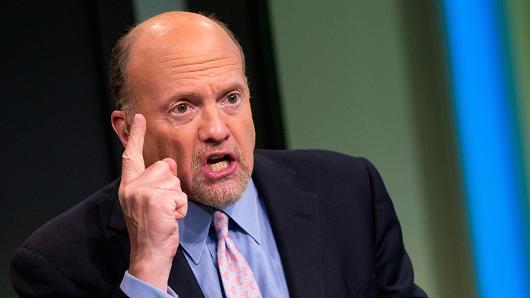
U.S. oil companies are going to be in a world of pain for a long time, especially after the latest OPEC meeting, CNBC's Jim Cramer said Monday.

"This is not 'longer and lower;' this is 'longer and much lower.' There's companies that are not going to be able to fund with futures; there're companies that are not going to be able to get credit," Cramer said on "Squawk on the Street."

Cramer made his remarks after the Organization of the Petroleum Exporting Countries decided not to lower production on Friday.

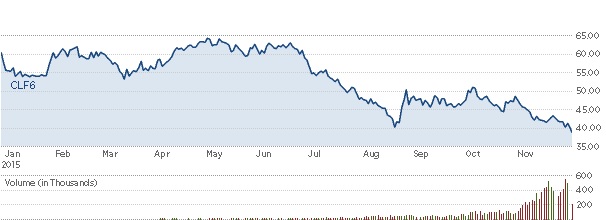
OPEC's decision pushed oil prices lower on Monday, with U.S. crude futures falling over 3 percent in midmorning trade. Internationally traded Brent also hit a 6½-year low.

"There is no cartel," Cramer said of OPEC. "The cartel was meant to keep the price controlled. They ended the cartel, and that's why this is happening."

US crude futures in 2015
 

VLCC Rates to Hold Steady After Hitting a New Five-Year High

Photo: Shutterstock/Anatoly Menzhiliy


SINGAPORE, (Reuters) – Freight rates in Asian trades for very large crude carriers (VLCCs) are likely to remain firm as vessel supply and charter volumes stay evenly matched, ship brokers said on Friday.

They have seen daily earnings soar by between $37,500-$42,000 in the last week.

That came as earnings from the Middle East to Japan hit more than 91 on the Worldscale measure on Thursday, equivalent to $111,359 a day, the highest level since June 23, 2010.

The surge was fuelled by unloading delays in China and South Korea caused by a shortage of storage tank space and other port infrastructure issues and bad weather that could disrupt vessels’ future charter fixtures, two European VLCC ship brokers said on Friday.

“Charterers had an absolute fear of not getting the right ship for the right cargo. That turbocharged activity – charterers came barging into the market with cargoes,” said one of the European brokers on Friday.

That is the third time this year VLCC freight rates from the Middle East to Asia have hit a five year high, Reuters freight data showed.

VLCC rates from West Africa to China also climbed, hitting the highest level since Oct. 15 on Thursday.

“No doubt owners are going to overplay their hand, looking for rates in three figures. But when the market gets silly charterers do alternatives,” the first European broker said.

Charterers are already taking steps to cool the market, holding back cargoes, splitting cargoes into smaller loads or better utilising their own tonnage by increasing vessel speeds, brokers said.

Unipec, the trading arm of Sinopec, chartered two smaller Suezmax tankers earlier this week rather than pay the high VLCC freight rates, brokers and Reuters chartering data showed.

A Suezmax tanker can carry 1 million tonnes, while a VLCC carries about 2 million tonnes.

“I don’t see rates coming off too much. I think owners will defend the W90 level,” a second European VLCC broker said.

Charterers have concluded around 105 fixtures for loading in the Middle East in December, with around 10-15 more cargoes still to be fixed, the two brokers said.

Freight rates for the Middle East to Japan benchmark route nudged above W91 on Thursday, up from 61.50 a week earlier.

VLCC rates from West Africa to China climbed to W80 on Thursday, against W67.50 the same day last week.

Rates for an 80,000-dwt Aframax tanker from Southeast Asia to East Coast Australia rose to W127.50 on Thursday, compared with W123 last week on strong cargo volumes and tight tonnage supply.

Clean tanker rates from Singapore to Japan slipped to around W107.75 on Thursday, from W108.75 last week. (Reporting by Keith Wallis, editing by William Hardy)

(c) Copyright Thomson Reuters 2015.

Friday, December 4, 2015

Oil settles up 3 percent on diving dollar, pre-OPEC hedging


NEW YORK (Reuters) - Crude prices settled up about 3 percent on Thursday, the eve of an OPEC meeting, as traders who expect no cuts in the group's output hedged their positions in case of a surprise outcome at a meeting of the world's largest oil producers.

A tumbling dollar and a surge in heating oil prices also supported the rally in crude, which neared 6-1/2 year lows just a day ago.

"Bear markets are known to have dramatic rallies," said Jeffrey Grossman, crude futures dealer at BRG Brokerage in New York. "I keep telling people how vulnerable a market this low is to upward action."

Brent crude settled up $1.35, or 3.2 percent, at $43.84 a barrel, rising more than $2 at the session high. On Wednesday, it had closed down almost $2, coming just about 20 cents from making a new low since March 2009.

U.S. West Texas Intermediate (WTI) crude settled up $1.14, or 2.9 percent, at $41.08. WTI's front-month January futures hit a contract low of $39.84 on Wednesday.

Crude prices have been volatile, reacting to remarks from oil ministers of the Organization of the Petroleum Exporting Countries who are gathered in Vienna for a meeting on Friday.

Brent rose more than $1 in early New York trade, then pared gains before rallying again in the afternoon.

Early gains came after a report sourced to a senior OPEC delegate said Saudi Arabia would next year propose a deal to balance oil markets with non-OPEC help. 

A Saudi oil source later dismissed that report, and Brent pared gains. The Saudis have so far resisted production cuts to support prices. Iran and Russia have also ruled out production limits.

But as Thursday's settlement approached, oil prices regained steam, rising more than 5 percent at one point. The surge surprised analysts, who said some traders were probably hedging against a possible surprise at the OPEC meeting.

"The idea that there could be a surprise cut is making people a little nervous," said Dominick Chirichella of the Energy Management Institute in New York.

The dollar fell 2.3 percent for its steepest one-day decline in more than 6 years as the euro surged on the European Central Bank's smaller-than-expected cut in interest rates on deposits. [USD/]

Heating oil settled up 4 percent after being depressed in recent days by a lack of cold weather in the northeastern United States, a major market for heating.

(Additional reporting by Catherine Ngai and Scott DiSavino in New York, and Karolin Schaps in London; Editing by Marguerita Choy, Diane Craft and David Gregorio)

Markets- New methanol production capacity to impact chemical trades

  FORECASTERS - Chemical Forecaster


New US and Middle East methanol production capacity being added over the next two years will have serious implications for chemical shipping trade flow patterns.
 
According to the latest edition of ‘Chemical Forecaster’, published by Drewry., methanol is one of the top five seaborne chemical commodities, accounting for 35% of the world seaborne chemical and vegoil trade in 2014.

Despite being the largest producer, by both capacity and output, China remains a net importer and will continue to drive demand for methanol exports out of North America and the Middle East.

The build-up of petrochemical capacity in the first wave of US projects, estimated at about 12 mill tonnes per year, presents a long-term competitive challenge for Europe and the Middle East’s petrochemical industry. Prior to 2015, the US imported around 5 mill tonnes of methanol per year, mainly from Trinidad & Tobago and Venezuela. Given these new capacity additions, the US will become a net exporter of methanol next year..

In the Middle East, Iran is the only country to have new projects and expansions in the pipeline. If sanctions are lifted in 2016, Iran will increase its methanol production by 20 mill tonnes between 2020 and 2025, with most of the incremental flows moving to Asian markets.

“The large volume of methanol supply will find new markets across the globe over the next five years. The addition of America’s new production capacity has weighed heavily on methanol prices, leading to a significant fall in both spot and contract prices in 2015,” said Drewry’s lead analyst for Chemical Shipping, Hu Qing.

By 2020, North and South America will export more than 9 mill tonnes of methanol to Northeast Asia, mainly China. Once North America starts exporting methanol to Asia, tankers with specialised coatings, such as zinc or marineline, interline and stainless steel, will benefit.

On the Transpacific routes, MRs with zinc-coated tankers are competitive, as the ship price and freight rates are lower, but with less flexibility compared to large stainless steel tankers.

“The average size of a methanol ship is expected to increase considering the long-haul distance between the major sources of supply and demand. Shipping costs will remain an integral part of the overall product price. The Middle East and US will be key sources of supply for the product, with China and India being the ultimate destinations,” added Qing. 

Frontline completes merger

Frontline.png

http://www.tankeroperator.com/ViewNews.aspx?NewsID=7206 

Leading tanker owners, Frontline 2012 and Frontline Ltd have completed their merger. 
 
Frontline is now the surviving legal entity and Frontline 2012 is a wholly-owned subsidiary.

The merger was consummated after close of trading on the Oslo Stock Exchange and close of the NOTC on 30th November, 2015.

Trading in the new shares of Frontline issued as a merger consideration to former Frontline 2012 shareholders started on the Oslo Stock Exchange on 1st December, 2015.

Prior to completion of the merger, Frontline had 198,375,854 common shares outstanding with a par value of $1 each. Following its completion, Frontline will have up to 781,937,956 common shares outstanding.

The exact number of shares outstanding will depend on rounding for fractions in connection with the issue of merger consideration shares, the company said.

Wednesday, December 2, 2015

Oil Prices Under Severe Pressure As U.S. Inventories Near 500 Million Barrels

oil storage, oil reserve


Forty-eight years to the day after David Bowie’s first single ‘Rubber Band‘ was released (??!!), and the crude complex is being stretched to the downside once more ahead of weekly inventory data.

Last night’s API report yielded a surprise 1.6 million barrel build to crude stockpiles, usurping expectations ahead of today’s EIA weekly report. A modest draw is expected from today’s report as refiners continue to return from maintenance; correspondingly a solid build to gasoline stocks is also in the mix.

It’s like our Christmases all come at once on Friday, with the double-whammy of Nonfarm payrolls and the OPEC meeting. The gang is starting to arrive in Vienna, with the usual ratcheting up of rhetoric hitting the news wires. Saudi oil minister Ali al-Naimi appears to be his usual prickly self; we’d be worried if it was any other way.

There’s an interesting piece in the Wall Street Journal today addressing the current oversupplied nature of the global crude market, although it is fairly dismissive that global inventories are getting full, pointing to the current structure of the futures curve for evidence.

The claim that near-term prices are not low enough to incentivize floating storage is legitimate, but it doesn’t explain away the current reality in the Gulf of Mexico: 51 vessels carrying around 38 million barrels of crude are sat waiting to discharge as of yesterday (h/t ClipperData). Nor does it explain the idling ships seen across the world recently, from Singapore to China to the Arab Gulf.

All the while, total US crude inventories sit at 488.2 million barrels, 105 million barrels higher than this time last year, and 2.7 million barrels shy of the all-time record of 490.9 mn barrels set earlier in the year. Mamma mia, that’s a spicy meatball of a level:

View gallery
.


(psst….don’t forget we also have 695 million barrels stored in the strategic petroleum reserve, which equals 137 days of net petroleum imports – although the Senate and House of Representatives agreed on a deal yesterday to sell 66 million barrels of it from 2023 to 2025 to raise funds).
 
From one downbeat market to another, we take a look at Asian spot LNG prices. Lest we forget, Asia accounts for ~75% of the global LNG market, with Japan and South Korea accounting for 50% of the global market between them. Hence, as demand growth slows in this key region just as supply capacity additions come to market (from Angola to Australia, and not forgetting the US), prices have tumbled a further 25% this year to $7.40/MMBtu currently.


This is after already dropping a whopping 45% last year. Spot prices could fall to $5.70 next year, as further supply additions come online.
.
Related: Are OPEC Countries Creditworthy At $50 Crude?

Taking a look at overnight action on the economic data front, and preliminary Eurozone inflation for November has disappointed, coming in at 0.1% (YoY), below consensus of 0.2%. Core inflation also disappointed, coming in at 0.9% (versus 1.1% expected). This preempts tomorrow’s European Central Bank meeting, and the likely announcement of further stimulus measures.

Onto the US, and the thunder-stealer from Nonfarm Friday (aka the ADP report) showed job creation of 217,000, last month, some 27,000 better than the consensus. Other than that, there is a bit of a pause in the beginning-of-the-month data dump, with just the excitingly-named Beige book out later today. Inbetwixt then and now, dollar strength may be stoked by Fed head honcho Janet Yellen speaking – and of course, our dearly beloved EIA report.

Given dollar strength and an impending bearish inventory report, the crude complex is looking lower once more.

Finally, we take a look at things that are never gonna happen via Venezuela’s President, Nicolas Maduro. He wins the prize for the quote of the day, saying ‘the hour has come to put the oil market in order‘, confirming that Venezuela are to push for a 5% output cut from Friday’s OPEC meeting. Don’t hold your breath.

By Matt Smith