Saturday, March 4, 2023

Friday, March 3, 2023
COVID-19 ‘Likely’ Originated From Chinese Lab: FBI Director
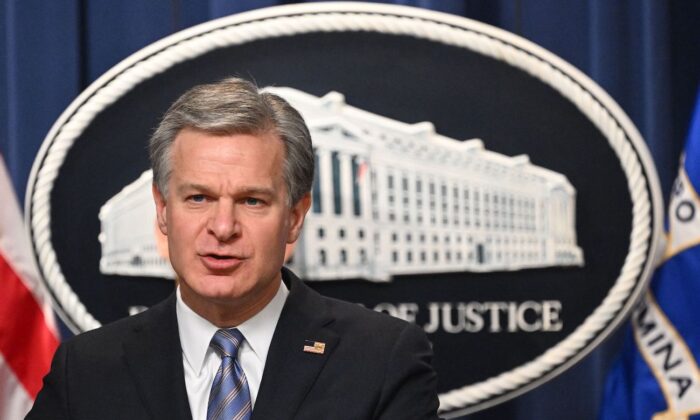
FBI Director Christopher Wray speaks during a press conference to
announce an international ransomware enforcement action, at the Justice
Department in Washington, on Jan. 26, 2023. (Mandel Ngan/AFP via Getty
Images)
FBI Director Christopher Wray has confirmed that the bureau assessed the COVID-19 pandemic likely resulted from a lab incident in Wuhan, China.
“The FBI has for quite some time now assessed that the origin of the pandemic are [sic] most likely a potential lab incident in Wuhan,” Wray told Fox News host Bret Baier in an interview late Tuesday.
“Let’s step back for a second. You know, the FBI has folks—agents, professionals, analysts, virologists, microbiologist, etc.—who focus specifically on the dangers of biological threats, which include things like novel viruses like COVID and the concerns that they’re in the wrong hands—some bad guys, a hostile nation state, a terrorist, a criminal—the threats that those could pose,” he said. “Here you’re talking about a potential leak from a Chinese government-controlled lab that killed millions of Americans.”
“I should add that the work related to this continues and there are not a whole lot [of] details that are unclassified.”
Wray also said he believes the Chinese Communist Party (CCP) has been interfering with efforts by the United States and other foreign nations to investigate the origins of COVID-19.
“The Chinese government, it seems to me, has been doing its best to try to thwart and obfuscate the work here—the work that we’re doing, the work that our U.S. government and close foreign partners are doing. And that’s unfortunate for everybody.”
The FBI’s Twitter account announced late Tuesday that Wray “confirmed that the Bureau has assessed that the origins of the COVID-19 pandemic likely originated from a lab incident in Wuhan, China.”
Wray’s comments come just days after the U.S. Department of Energy (DOE) released a classified report to the White House and key members of Congress that concluded the virus mostly likely came from a lab leak, reported the Wall Street Journal (WSJ) on Feb. 26, citing unnamed sources. The new conclusion was reportedly reached due to new intelligence, according to the outlet.
Intelligence officials told WSJ and CNN there is “low confidence” in the conclusion. The FBI, according to WSJ, had previously concluded that COVID-19 originated from a Wuhan lab with “moderate confidence.”
According to the WSJ, the FBI made its determination for “different reasons” compared to the DOE. Meanwhile, four other U.S. agencies and the National Intelligence Council currently believe COVID-19 resulted from natural transmission from animals to humans at a wet market in Wuhan, and two other agencies, one of which is the CIA, are undecided, per the outlet.
The Epoch Times has reached out to the DOE for comment. A DOE spokesperson told WSJ and CNN that the department “continues to support the thorough, careful, and objective work of our intelligence professionals in investigating the origins of COVID-19, as the president directed.”
China has long dismissed the possibility of a lab leak. In response to the WSJ report, Chinese Foreign Ministry spokesperson Mao Ning said on Feb. 27: “The origin of the novel coronavirus is a scientific issue and should not be politicized.”
The origin of SARS-CoV-2, the virus that causes COVID-19, has been a contentious topic since the start of the global pandemic in early 2020.

The Wuhan Institute of Virology (WIV), located in central China’s Wuhan city, is at the center of questions surrounding the origins of the virus. The CCP has never allowed independent investigation into the facility.
Virologist Shi Zhengli, the director of the Center for Emerging Infectious Diseases at the WIV, also known as China’s “bat woman,” has also been prominent in the discussions surrounding COVID-19’s origins. For over a decade, Shi has been testing how different coronaviruses from animals can infect humans.
The WIV, which houses a P4 lab (the highest biosafety level), has denied having ties to China’s military.
But for years, it has worked with military leaders on a state-sponsored project conducting laboratory animal experiments.
Separately, a fact sheet by the U.S. State Department in January 2021 stated that the WIV has engaged in laboratory animal experiments on behalf of the Chinese military since at least 2017, and worked on “gain-of-function” research to engineer chimeric viruses.
According to the January 2021 fact sheet, in the autumn of 2019, several researchers at WIV fell ill with symptoms similar to those caused by COVID-19.
Furthermore, during the initial stages of the COVID-19 pandemic in early 2020, Beijing sent Chen Wei, a top Chinese expert in biology and chemical weapon defenses, to take over the lab. Wei is a major general for the People’s Liberation Army, which is the CCP’s military wing.
Jackson Richman contributed to this report.
Glencore ordered to pay $700 million by US judge in bribery case
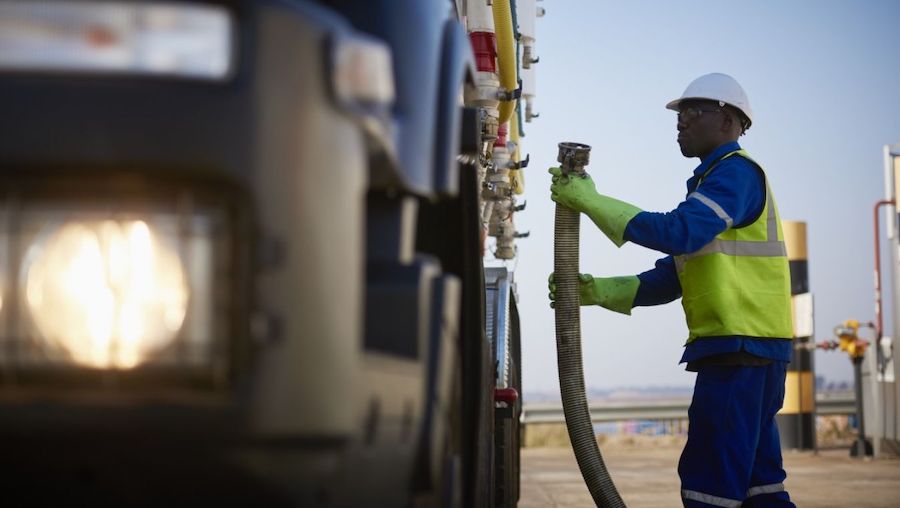
Glencore pleaded guilty to seven counts of bribery in connection with oil operations in five African countries. (Image courtesy of Glencore.)
https://www.mining.com/web/glencore-ordered-to-pay-700-million-by-us-judge-in-bribery-case/
Glencore Plc was ordered by a federal judge in New York to pay $700 million as a criminal punishment for a global bribery scheme orchestrated by the Swiss-based commodities trading and mining giant.
US District Judge Lorna G. Schofield on Tuesday imposed the sentence, following the terms of a plea deal with prosecutors entered when Glencore pleaded guilty in May to a single count of conspiring to violate the Foreign Corrupt Practices Act. The company must pay a fine of $428.5 million and $272.2 million in criminal forfeiture.
The penalty, one of the largest in a foreign corruption case, is part of the $1.5 billion Glencore agreed to pay to resolve bribery and market-manipulation probes in the US, UK and Brazil. Glencore units agreed to plead guilty to a list of charges ranging from bribery and corruption in South America and Africa, to price manipulation in US fuel-oil markets.
Glencore was guilty of “a very serious offense,” Schofield said, though he noted the company’s efforts to cooperate with the government and to beef up compliance procedures after receiving a federal grand jury subpoena in 2018.
Prosecutors claimed Glencore paid more than $100 million in bribes to government officials in Brazil, Nigeria, the Democratic Republic of the Congo and Venezuela. They said Glencore made $315 million from the scheme.
In addition to the fine and forfeiture, Glencore will spend five years on probation, continue with improvements to its ethics and compliance programs and employ an outside monitor for three years.
Glencore conducted an internal investigation, eventually disciplining more than 20 people, a lawyer for the company said during the hearing Tuesday in Manhattan federal court. Glencore produced more than 1 million documents, many from outside the US, and hired a forensic accounting firm to look into suspect trading activity.
On Monday, Schofield ruled Glencore must pay $29.6 million to the founders of a company that provided healthcare services in 11 African countries, but was forced to shut down. Crusader Health claimed it was driven out of business after Glencore bribed a public official in the Democratic Republic of the Congo to throw out a lawsuit brought by Crusader against a Glencore subsidiary.
In September, the commodity firm was sentenced in Connecticut to pay $486 million in fines and forfeitures in a case in which Glencore admitted conspiring to manipulate oil-price benchmarks. In November, a London judge imposed a £276 million ($333 million) penalty for Glencore’s effort to bribe government officials for access to oil cargoes across Africa.
The case is US v. Glencore, 22-cr-00297, US District Court, Southern District of New York (Manhattan).
(By Bob Van Voris)
A $1.5 billion hoard of copper and cobalt is piling up in Congo
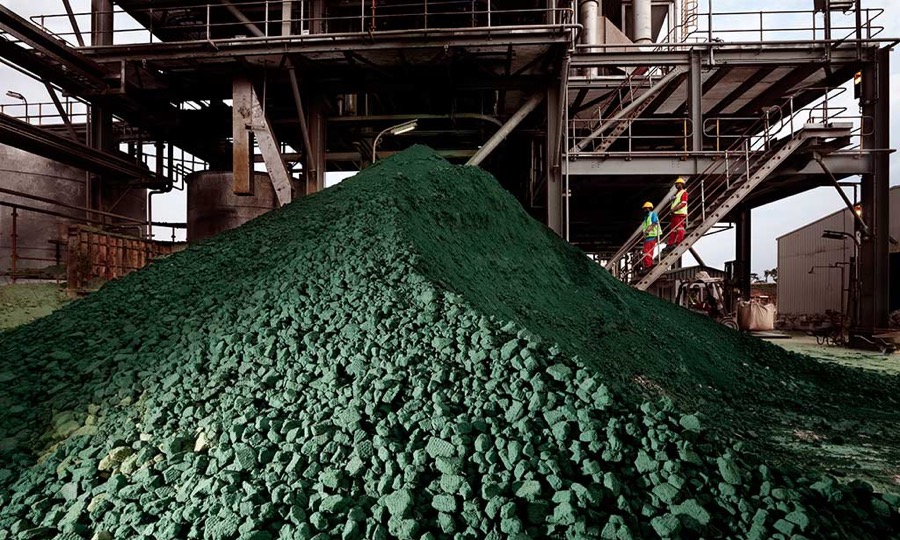
Processing facilities at Tenke Fungurume mine. (Image courtesy of Lundin Mining.)
https://www.mining.com/web/a-1-5-billion-hoard-of-copper-and-cobalt-is-piling-up-in-congo/
A growing pile of copper and cobalt worth about $1.5 billion is stranded in the Democratic Republic of Congo, caught up in a standoff over the future of one of the world’s biggest battery-metal mines.
The huge stash of metal is owned by China’s CMOC Group Ltd, which is locked in a dispute with its Congolese state-owned partner over royalty payments. While its exports were blocked in mid-July, CMOC’s Tenke Fungurume mine has kept running at close to full capacity, simply stockpiling the extra metal until it can resume shipments, according to people familiar with the matter.
The logjam is a stark reminder of the vulnerabilities in electric-vehicle supply chains, which rely heavily on a small clutch of mines in a handful of countries — in the case of cobalt, Congo is by far the largest supplier. Battery metal prices have become increasingly volatile as producers struggle to match output to demand, creating headaches for automakers on the upswings, and miners on the way down. The Tenke Fungurume stockpile raises the threat of more sharp swings to come.
By now, there are about 120,000 tons of copper and around 12,500 tons of cobalt stuck waiting to leave the country, according to people familiar with the matter and Bloomberg calculations. The copper accounts for the bulk of the value, at about $1.1 billion at spot prices, but it only represents about 7% of total global monthly production, and is unlikely to affect international prices when it does hit the market.
For cobalt, however, the implications could be seismic.
Tenke Fungurume accounts for about 15% of global supply — a larger share of production than the 10% slice of global oil output controlled by Saudi Arabia. Surprisingly, the market has managed quite well without Tenke’s cobalt, because demand for use in electronics has fallen and output elsewhere is increasing, sending prices tumbling more than 60% from a peak last year. The eventual release of the CMOC stockpile could drive them much lower still.
At the heart of the issue is state miner Gecamines’ claim that CMOC has been lying about its mineral reserves and owes the company $7.6 billion in royalties and interest. The pair also need to negotiate a sales contract to set the terms for future exports.
Part of the reason that the stockpile has become so large is that CMOC has remained hopeful throughout the dispute that a resolution was close, which kept it from dialing back activity at the site, according to people familiar with the operation.
Yet a deal has so far proven elusive. Every day, roughly 500 tons of copper and 50 tons of cobalt are being added to the stash of metal, creating a growing logistical and commercial headache for CMOC and its partners.
And when the stockpile does eventually start to move, it’s likely to spark a scramble for trucks in the region, driving up freight costs and adding to the chronic logistical logjams at the Congolese border.
CMOC did not reply to an email seeking comment. Gecamines Deputy Chief Executive Officer Leon Mwine Kabiena, who oversees the Tenke mine portfolio for the Lubumbashi-based company, did not immediately provide comment when contacted by Bloomberg on email.
The Tenke stockpile has cast a long shadow over the cobalt market, turning once-firm bulls like top producer Glencore Plc into reluctant pessimists.
Still, CMOC’s role in the market and deep pockets mean it will have little incentive to dump the metal.
The Chinese company has a market capitalization of about $17 billion, and said last year that Contemporary Amperex Technology Co. Ltd. — the world’s largest EV battery-maker — had agreed to buy a 25% stake. It also owns IXM, a major metals trading house.
“CMOC have had the balance sheet to operate the mine and stockpile the material throughout this period, so I don’t think they’ll be under pressure to offload it overnight in a fire sale,” said Caspar Rawles, chief data officer at Benchmark Mineral Intelligence, which estimates the size of the cobalt stockpile at 10,000 to 12,000 tons. “But at some point they will have to sell, and there’s more than enough material around already.”
(By Mark Burton and Michael J. Kavanagh, with assistance from Jack Farchy and Winnie Zhu)
Jindalee claims McDermitt project is the largest lithium deposit in US

Australia’s Jindalee Resources (ASX: JRL) says it has the largest lithium deposit in the United States after updating the resource for its McDermitt project to 21.5 million tonnes of lithium carbonate equivalent (LCE), up 65% from the 13.3 million tonnes reported last year.

The asset, on the Nevada-Oregon border, is now estimated to hold combined indicated and inferred mineral resources of three billion tonnes grading 1,340 parts per million. This makes it the biggest lithium deposit in the US by contained lithium in mineral resource, Jindalee Resources said.
The project has taken over Lithium America’s (TSX, NYSE: LAC) 16.1 million tonnes of LCE Thacker Pass project, in the southern sector of the McDermitt caldera.
Jindalee believes its project can play a role in the US battery push as a source of domestically produced lithium supply.
The company hopes to tap into funding under the White House’s $369 billion Inflation Reduction Act, which has already granted a $700 million loan for Rhyolite Ridge and up to 75% of the capital expenditure costs for Thacker Pass.
Colonial Pipeline Pursuing Expansion of Greensboro Operation
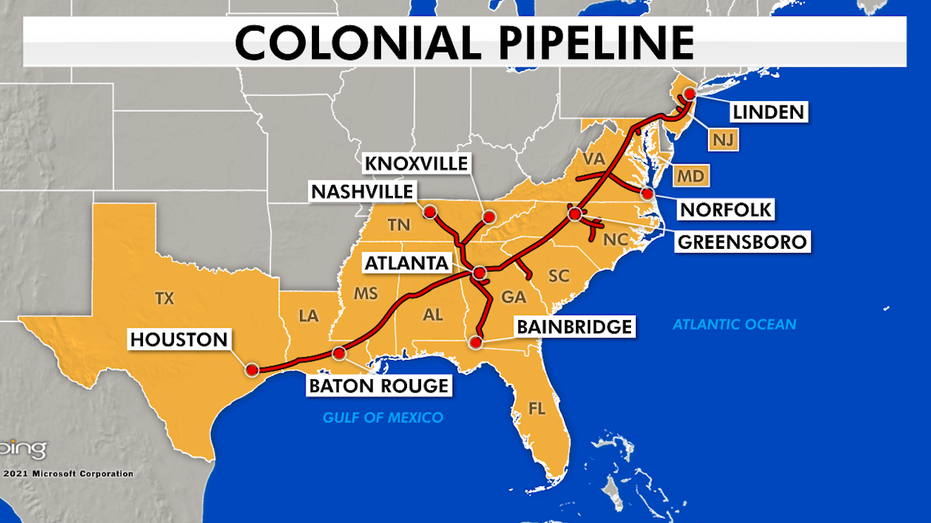
Colonial Pipeline, which operates a 5,500-mile system transporting
petroleum from the Gulf Coast to the Northeast, is pursuing expansion of
its Greensboro tank-farm facility.
The Atlanta-area-based company has a special-use request before the city of Greensboro Board of Adjustment for property it acquired last year near its tank farm along I-40. The request will be considered at a meeting Monday, Feb. 27, 2023, at 5:30 p.m. in the Council Chamber of the Melvin Municipal Building.
A company statement to the TBJ said the company and affiliates are pursuing potential projects at the Greensboro facility.
“The projects would include the extension of operations onto an adjoining property that we have acquired. As part of this, our due diligence includes ongoing conversations with key stakeholders and applications for relevant permits and clearances, some of which are the subject of Monday’s hearing. Protecting the safety of our people, our neighbors, the public, and the environment is our top priority, and we are committed to meeting or exceeding all regulatory requirements related to this project.”
The permit being sought is at 736 South Chimney Rock Road. The company bought 1.6 acres there last April for $40,000, according to Guilford County property records.
The operations that would be added include an area accessible from Chimney Rock Road where trucks can offload product and construction of a new tank and other equipment inside the existing fence line, according to a company spokesman.
Greensboro is a junction point in Colonial’s pipeline system where a spur runs off the main trunk to deliver fuel products to terminals in Raleigh-Durham, Apex, Selma and Fayetteville.
The 73 storage tanks on I-40 hold various products awaiting transport through the system to points around the Southeast or to be transported farther north in the pipeline system.
The Greensboro tank farm is where the company’s lines 1 and 2, which originate in Houston, end, and where lines 3 and 4 begin and head north. Line 4 ends in Maryland and line 3 continues to Linden, New Jersey.
Exxon Attempting to Start New CDU at Beaumont, Texas Refinery - Sources

Exxon Mobil Corp (XOM.N) is attempting to start the new crude distillation unit (CDU) at its 369,024 barrel-per-day (bpd) Beaumont, Texas, refinery, people familiar with plant operations said on Thursday.
Exxon hopes to put the first oil in the new $2 billion 250,000-bpd CDU C over the weekend in the initial startup of the unit, which will increase the refinery’s capacity by 68% once it is in full operation, the sources said.
Exxon is also repairing a 100,000-bpd vacuum distillation unit (VDU) attached to the 180,000-bpd CDU B at the refinery, the sources said.
An Exxon spokesperson did not have an immediate comment.
Exxon has said it plans to bring CDU C to full production by the end of the first quarter.
This is third scheduled attempt to complete the initial startup of CDU C. The first attempt was postponed and the second prevented by a need to repair a catalytic hydrotreater. Repairs on the hydrotreater are continuing, the sources said.
When CDU C reaches full production, the Beaumont refinery will be at least the second-largest in capacity in the United States.
However, increased production efficiencies on the two CDUs operating at the refinery, plus the possibility CDU C could exceed its nameplate capacity of 250,000 bpd, may make the Beaumont refinery the largest in the nation.
Currently, the 626,000-bpd Motiva Enterprises (MOTIV.UL) refinery in Port Arthur, Texas, is the largest, according to the U.S. Energy Information Administration.
Exxon built the crude unit to process new crude oil production from the Permian Basin in Texas and New Mexico developed in the past decade.
CDUs operate at atmospheric pressure to break down crude oil into feedstocks for all other units at the refinery. VDUs operate at vacuum pressure to break down residual crude from the CDUs, boosting the yield from a barrel of crude.
Hydrotreaters use hydrogen to remove sulfur from motor fuels and their feedstocks in compliance with U.S. environmental rules.