An estimated one million bpd of crude oil has been taken off the
market due to the wildfire that has been raging in Alberta, Canada.
According to reports, daily production is down by an estimated 800,000
to 1 million bpd.
While no facilities or pipelines have been
damaged due to the wildfire, staff from the facilities have been forced
to evacuate. The evacuation has resulted in a lack of manpower to keep
facilities up and running.
Paul Newmarch, a spokesman for Suncor
Energy Inc., one of the operators in the region, said that prior to the
wildfire, the company was producing about 300,000 bpd; now it is
producing none, due to it shutting down operations at three facilities
north of Fort McMurray.
He was known to some as the Alan Greenspan of the oil world.
That is Ali al-Naimi, Saudi Arabia’s powerful oil minister, who was fired from his post on Saturday. He will be replaced by Khalid-al Falih, the chairman of the country’s state oil company, Saudi Aramco.
“This
is a historic one. [Al-Naimi] is the guy who for all intents and
purposes has been the global oil market for the last 30 years,” said
Phil Flynn, senior market analyst at Price Futures Group.
Al-Naimi gained global respect for turning the biggest
oil cartel in the world, otherwise known as the Organization of the
Petroleum Exporting Countries (OPEC), into a respectable organization,
Flynn said in a telephone interview. And just as former Fed Chairman
Greenspan would lower or raise interest rates when he thought the market
needed it, al-Naimi would add or hold back on oil depending on the
energy market’s needs, he added.
The move has reminded some who
is ultimately in charge. While al-Falih, the new oil minister, now has
one of the most powerful posts in the world, Flynn said there is no
doubt that 36-year old Deputy Crown Prince Mohammed bin Salman is
running the show in Saudi Arabia. “This guy is the new power broker in
that country,” he said.
Some
saw the writing on the wall for al-Naimi after major oil producers
failed to reach a deal to freeze production in Doha, Qatar last month.
While al-Naimi had previously said a deal was possible even if Iran
didn’t take part, Prince Mohammed by all accounts put his foot down and
no deal was done.
AFP/Getty Images
Khalid al-Falih, pictured in January.
Worry about al-Falih?
Flynn said al-Naimi survived as many of his buddies were fired under
Prince Mohammed’s father, King Salman bin Abdulaziz Al Saud. He said
King Salman stopped short of axing al-Naimi because of the respect he
commanded both in the country and abroad. It was clear, he said, that
al-Naimi didn’t have the power to get a deal done at Doha.
But
what some may not realize is that al-Falih also commands much respect in
the oil world, said Jason Bordoff, a professor at Columbia University
and founding director of the Center on Global Energy Policy in New York.
“Everyone who pays attention to Saudi Arabia and oil prices knows
Khalid al-Falih is very widely regarded and respected as a capable
leader of Saudi Aramco,” he said in a telephone interview.
Al-Falih
has been working closely with the Prince Mohammed and seems to have the
“confidence and trust of him,” said Bordoff, who served as White House
energy adviser to President Barack Obama from 2009 to 2013.
“Saudi
Aramco is widely regarded as one of the most technically sophisticated
oil companies in the world, and I’ve had some personal dealings with
Khalid and many other people who have view him as an incredibly
impressive and smart and capable person,” he said.
Before
Saturday’s announcement, Al-Falih had been the country’s health
minister, tackling a problematic area of the country’s economy, he said.
As
for al-Naimi, no one should be that surprised at an 81-year old, who
had spoken for years of retiring, is finally leaving that powerful oil
post, he said.
Where now for oil prices? If
there’s one thing that rattles the oil market, that’s any sort of
surprise, and it’s fair to say the market may get the jitters over the
news out of Saudi Arabia.
The Doha meeting created
uncertainty for the oil market as well as questions over Saudi Arabia’s
futures policies and whether it will rise to the occasion such as in the
past, raising and lowering global oil production when it was needed for
the rest of the world, said Flynn.
Now uncertainty in the wake of Saturday’s news could give oil prices a push in the near term, he said.
“My
assumption is that we’re in a globally oversupplied market. The market
might look at it two ways: more uncertainty is bullish overall, though
in the short term there is this perception that Saudi Arabia may flood
the market with oil,” said Flynn.
Just ahead of the failed Doha meeting, Prince Mohammed told Bloomberg in an interview
that his country could boost its daily production number by as much as
20 million barrels if it invested in production capacity and by up to
11.5 million barrels a day right away. But Flynn said that given the
country is seeing a strain on its finances because of weak oil prices,
it can’t really afford to start ramping up production by more than a
small amount.
He said it would be worth watching China closely as
for how well the oil market deals with news of a new oil minister in
Saudi Arabia. The Shanghai Composite
SHCOMP, -2.79%fell nearly 3% on Friday on worries about looming bond defaults.
China crude imports in March were the second-highest on record,
and any signs that the economy or stocks are stressed will lead the oil
market to believe the country could curb that demand, said Flynn. But
he’s ultimately optimistic about prices, provided the Chinese economy
doesn’t fall apart.
If the Chinese economy does melt down again,
he said the market will be talking about a glut, and if things
stabilize in China, the conversations will be quite different, more
along the balance side.
Bordoff said he doesn’t see much
reaction coming from the oil market, though he agrees the changing of
the guard could drive prices up in the short term.
“We’ll be
watching the next 24 to 48 hours to see if any other news comes out. I
don’t think that this was that unexpected. I don’t think people will
view it as any indication that large-scale changes are imminent in Saudi
oil policy,” he said.
West Texas Intermediate futures
CLM6, -1.79%
finished last week down 2.7%, while Brent crude
LCON6, -2.53%
the global oil benchmark, slid 4.2%. Oil gained on Friday,
though as news of wildfires in an oil-rich region of Canada and
disruptions to an offshore oil facility in Nigeria outweighed a
disappointing U.S. jobs report.
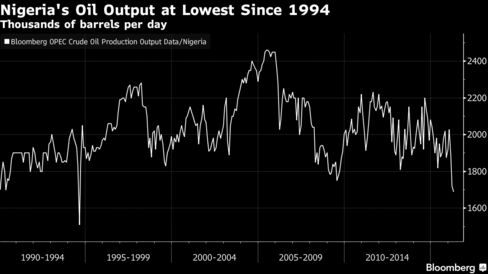
Nigeria
is suffering a worsening bout of oil disruption that has pushed
production to the lowest in 20 years, as attacks against facilities in
the energy-rich but impoverished nation increase in number and audacity.
Chevron
Corp. shut down about 90,000 barrels a day of output following an
attack on a joint-venture offshore platform that serves as a gathering
point for production from several fields. Even before that strike on
Wednesday night, Nigerian oil production had fallen below 1.7 million
barrels a day for the first time since 1994, according to data compiled
by Bloomberg.
“This
is some very, very sophisticated brazen attack,” said Dolapo Oni, the
Lagos-based head of energy research at Ecobank Transnational Inc. “It is
a resurgence of militancy. These guys don’t seem to be after money.
They just want to frustrate the government.”
The
fresh round of attacks come after President Muhammadu Buhari vowed to
stamp out corruption and oil theft. They echo a campaign waged by the
self-proclaimed Movement for the Emancipation of the Niger Delta between
2006 and 2009, which cost the Nigerian government billions of dollars
of lost oil revenue. That violence abated after thousands of fighters
accepted an amnesty from late-President Umaru Musa Yar’Adua and
disarmed, in exchange for monthly payments from the government in some
cases.
Facility Breached
Chevron said it shut down its
Okan offshore facility after it was “breached by unknown persons” and
had sent “resources to respond to a resulting spill.” The U.S company on
Friday said that 35,000 barrels a day of its own net production was
affected. Okan, which feeds crude and gas into Escravos, one of the
country’s largest export facilities, is jointly owned by Chevron, with a
40 percent stake, and state-owned Nigeria National Petroleum Corp.,
which has the rest, according to NNPC’s website.
A group calling
itself the Niger Delta Avengers said on its website that it was
responsible for the attack. The authenticity of the claim could not be
verified by Bloomberg News.
The Nigerian government is struggling
to contain the economic damage of the slump in energy prices and
separate attacks in the north of the country by the Boko Haram Islamist
insurgency. The country’s foreign reserves have fallen to less than $27
billion, the lowest since 2005. The International Monetary Fund expects
the economy to expand 2.3 percent this year, the weakest growth since
1999.
"Lower oil prices have
meant that the poorer oil-producing countries don’t have enough money to
pay for social services,” said Ehsan Ul-Haq, senior oil analyst at KBC
Process Technology Ltd. “Protests are increasing as a result."
Force Majeure
In
February, Royal Dutch Shell Plc declared force majeure -- a legal
clause that allows it to stop shipments without breaching contracts --
after an attack on a pipeline feeding the Forcados terminal, which
typically exports about 200,000 barrels a day.
The International
Energy Agency estimated last month that Nigeria could lose an estimated
$1 billion in revenue by May, when it expects repairs on Forcados to be
completed. The terminal may not restart until June, Nigerian Oil
Minister Emmanuel Kachikwu said April 20.
Major oil companies like
Shell, Chevron, Total SA, Eni SpA and ConocoPhillips, which for five
decades dominated the Nigerian oil industry, have been selling onshore
and shallow water oil fields in the Niger delta to local companies,
concentrating their investments in deep-water fields outside the reach
of militants.
"If prices remain low, we will see more and more problems including these kind of sabotage attacks," said Ul-Haq.
Ship
operators who rely on a myriad of companies for their global bunkering
needs are wasting time, money and energy, Wilhelmsen Ships Service (WSS)
claimed.
With no guarantee of standardised quality of products and services in
an industry defined by tight margins and cost constraints, this approach
is ultimately bad for business, WSS said.
WSS is now offering an alternative- bunker service agreements. These
are claimed to provide shipping companies with peace of mind and uniform
quality, as WSS’ global agents lead the process for the customer, to
help ensure efficient communication, minimised administration and high
standards. Everything is streamlined - with predictable pricing for a
clear set of deliverables with no hidden extra fees.
WSS estimated that there are over 80,000 bunker-only port calls each
year. Although these are relatively simple operational tasks, they come
with a complex web of administrative and qualitative considerations, as
highlighted by Daniel Wikstroem, Business Manager, Ships Agency, WSS,
who said;“Bunker-only calls can be a real headache for ship operators
used to high quality, efficiency and performance driven day-to-day
operations.”
“Typical bunker calls include up to 40 lines of communication, between
an array of parties – including port agents, bunker brokers and bunker
surveyors – up to two separate financial transactions, and an excessive
administrative workload checking disbursement accounts. Multiply this on
a global level, on a port-by-port basis, and there is huge room for
unpredictability – in terms of the complex delivery chain – and a
massive man-hour inefficiency. And it goes without saying that time is
money.
“Shipping firms will rely on their bunker brokers, or procurement
departments, to select the right fuel supplier, but what information can
they themselves access with regards to typical bunkering times?
Reliability? Punctuality? Ease of use? These factors make a real
difference between a seamless bunkering process and a convoluted,
lengthy and therefore costly one. There’s an opaque area here where it’s
very easy to lose time and money,”he explained.
With this in mind, WSS is advising ship operators to adopt a ‘one stop
shop’ strategy. The Oslo-headquartered business, which undertook over
4,000 bunker-only calls, at over 150 ports, last year, uses its global
network to offer Bunker Service Agreements.
A uniform global bunkering routine ensures that each call runs
smoothly, with, amongst other things: pre-arrival formalities and ISPS
requirements completed 24 hours prior to arrival; bunker suppliers,
surveyors, port authorities and pilots always given vessel ETA updates;
service boats always ready for bunkering surveyors upon arrival, and
completion; and a strict following up of all bunkering progress, WSS
claimed.
Wikstroem said that by switching to the WSS bunkering solution, a
typical client performing around 100 annual bunker calls, would save
over $20,000 per year through reduced bank transactions and paperless
disbursement accounts handling alone.
In addition, WSS’ worldwide operation allows it to accumulate detailed
performance records of suppliers, giving it, and its customers, an
intimate barge-side knowledge of all bunker operations in all major
bunker ports.
“Our completely independent, expert insight can cut through any
potential uncertainty relating to suppliers and lead to enhanced
decision making… and efficiency,” Wikstroem said.
The VLCC market is on a roll over the course of the past few weeks.
In its latest weekly report, shipbroker Charles R. Weber said that “the
pace of VLCC chartering was at a one‐month high this week as charterers
were busier following last week’s lull. A total of 27 fixtures were
reported in the Middle East market (+93% w/w) and seven were reported in
the West Africa market (+75%, w/w). Notably, all of this week’s West
Africa fixtures were covered on units ballasting from Asia, but despite
the corresponding strong level of draws on Middle East availability,
rates corrected sharply over the course of the week with the benchmark
AG‐FEAST assessment setting a fresh YTD low of ws46 towards the close of
the week (which also represents significant erosion from the ws92.5 at
which the route commenced April)”, said the shipbroker.
According to C.R. Weber “one factor behind this week’s rate slump is
that much of the Middle East market’s inquiry was oriented to the start
and the end of the week, leaving a much quieter mid‐week period which
negatively impacted sentiment. Another factor behind this week’s rate
losses was the fact that charterers were covering nearer forward dates
which alleviated some of the uncertainty inherent to normal forward
windows amid ongoing operational delays in Asia; as the pool of units in
play were already largely undertaking ballasts all were able to be
seriously considered for fresh requirements. For their part,
supply/demand fundamentals continued to disjoint. We note that with 60
May cargoes covered to date, we anticipate only up to 5 additional
cargoes remain uncovered. Against this we note that there are 19 vessels
available and even if assuming that draws to service West Africa
cargoes remain steady from this week’s level, the implied surplus at
mid‐May is 8 units in a low case. Through the end of the second decade
of May’s loading program that surplus could rise to 15 (excluding any
hidden positions). Given the extent of this week’s rate losses and the
fact that while availability levels have expanded they remain manageable
at present rates, we expect that rates will stabilize during the
upcoming week”.
Middle East
“Rates on the AG‐FEAST route dropped 12 points over the course of the
week to a closing assessment of ws48. Corresponding TCE fell 32% to
~$30,134/day. Rates to the USG via the Cape were off by 5.5 points to a
closing assessment of ws33.5. Triangulated Westbound trade earnings
declined by 10% to ~$59,690/day at present”, said CR Weber. Similarly,
in the Atlantic Basin, “rates in the West Africa market continued to
follow the direction of those in the Middle East. The WAFR‐FEAST route
concluded the week at ws56, off 6.5 points from a week ago.
Corresponding TCEs observed a weekly loss of 17% at a closing assessment
of ~$40,813/day. The Caribbean market remained slow with the CBS‐ SPORE
route holding at the $5.25m level”.
Suezmax
“Chartering activity levels in the West Africa market were largely
unchanged this week with a total of 12 fixtures representing a weekly
increase of one. Charterers have moved slowly past May’s first decade
loading period which has kept stronger activity levels at bay for now
but; simultaneously, low VLCC coverage of the month’s program thus far
leaves more cargo available to Suezmaxes which should drive demand in
the coming weeks. The recognition of this fact has seen owners more
resistant to lower rates and the WAFR‐UKC route was steady at ws82.5
while the WAFR‐USAC route eased by a modest 2.5 points on recent
strength in the Caribbean likely to maintain limited slower demand
levels for the larger tanker which in the coming weeks should see
realized Suezmax demand strength. Between potential imminent demand
strength and the probability that such will remain when charterers
progress into June, rates are likely to remain steady early during the
upcoming week with possibly firming thereafter”, said CR Weber.
Aframax
According to the shipbroker, “the Caribbean Aframax market commenced the
week with strong rate gains after surprisingly demand materialized late
last week with positive sentiment extending to the start of this week.
However, as the week progressed the upward trend subsided once market
participants realized that some units reportedly on subjects were either
erroneous or had failed, leaving a less tight fundamentals profile.
Having reached ws145 on Monday, the CBS‐USG route moderated to the low
ws140s at which it remained through the remainder of the week. Sentiment
concludes the week slightly soft due to a late‐week demand lull;
however, with supply/demand balanced relative to present rates we expect
that ws140 will represent a floor early during the start of the
upcoming week with no major impetus for positive or negative progression
presently evident”.
Panamax
Finally, “the Caribbean Panamax market was markedly more active this
week with a surge of regional fixtures appearing early during the week
while some swaps and stronger Aframax rates added to the pressure. As a
result, the CBS‐USG routed observed a weekly gain of 15 points to a
closing assessment of ws120. Failing a fresh demand surge early during
the upcoming week, supply/demand fundamentals appear balanced though
some units incoming from the Med and a less hectic pace could see rates
moderate from the present high”, said CR Weber.
Nikos Roussanoglou, Hellenic Shipping News Worldwide
On
April 27, 2016, Genscape Vesseltracker detected a shipment of 4,200
tons (about 1.3 million gallons) of biodiesel from Australia arriving at
the Texas Terminals Wharf in the Houston area. The Stolt Sun vessel
carried the product that originated from the ports of Adelaide and
Fremantle in Australia.
According to data from the EIA,
the U.S. hasn’t seen imports of biodiesel from Australia since January
2013, and the shipments from Australia have only occasionally occurred
in the EIA’s recorded history (February 2012 and May 2011).
What is interesting about Australian biodiesel imports?
According to the 2015 USDA FAS GAIN
report, Australia only produced about 17 million gallons of biodiesel
in 2014. When the report was issued in August 2015, the expectation was
that there would be 26 million gallons produced in 2015. The USDA also
reported that only four of the eight biodiesel plants in Australia were
operating at that time.
Genscape Vesseltracker tracking of an Australian biodiesel import to the U.S. Click to enlarge
U.S. imports would suggest little Australian demand for biodiesel and
favorable economics stateside with the current regulatory incentives,
even with the nearly two-month journey.
What are the potential implications?
The Blender’s Tax Credit, increased Renewable Fuel Standard volumes,
and the value of Low Carbon Fuel Standard credits are driving increased
U.S. consumption of biodiesel in 2016. A big question for the industry
is how much of that will come from non-U.S. versus U.S. sources. Seeing
another source of imports that wasn’t in the market in 2014 and 2015
could be an indication of the strength of imports in fulfilling
increased demand.
Using Genscape Vesseltracker AIS data and proprietary ship tracking,
the Global Biodiesel Monitor provides stakeholders with access to key
international shipment information to deliver a more complete picture of
biodiesel and renewable diesel flows worldwide. To be in the know about
U.S. imports of biodiesel and renewable diesel in this pivotal year for
advanced biofuels, contact Genscape for a free trial to the Global
Biodiesel Imports Monitor. With your trial subscription, you will
discover the consignee that received the Australian shipments and all
other biodiesel and renewable diesel imports. Click here to learn more or request your free trial now.


 AFP/Getty Images
 AFP/Getty Images