Friday, August 29, 2025

Petrobras to re-enter Nigeria five years after halting JV operations


https://worldoil.com/news/2025/8/27/petrobras-to-re-enter-nigeria-five-years-after-halting-jv-operations/?oly_enc_id=1027J2600390B9V

During a state visit to Brasilía this week, Nigerian President Bola Tinubu focused on deepening economic cooperation and unlocking strategic partnerships, and welcomed Petrobras’s planned re-entry into the Nigerian market. The two countries signed five Memoranda of Understanding covering trade, energy, aviation, science and finance, signaling a shift from symbolic ties to practical, high-impact collaboration. 

Five years after halting its joint venture operations, the Brazilian state-owned oil company is set to re-enter the Nigerian market, bringing not only investment but critical expertise in gas and oil development.

While Petrobras’ full re-entry into Nigeria is not yet finalized, the visit underscores renewed interest in strategic collaboration. Petrobras brings extensive experience in deepwater oil exploration, gas development and operational excellence – capabilities that could significantly accelerate the development of Nigeria’s vast hydrocarbon resources. Nigeria holds some of the continent’s largest untapped gas reserves – estimated at 210 trillion cu. ft – offering immense opportunities for domestic energy development, industrialization and export growth.

“The planned return of Petrobras to Nigeria is a landmark moment that signals confidence in Africa’s energy sector and its long-term growth prospects,” said NJ Ayuk, Executive Chairman of the AEC. “It is a clear message to global investors: Africa is open for business, and partnerships with experienced operators like Petrobras will ensure the continent’s energy resources are developed sustainably and profitably.”

The implications of this renewed partnership extend across multiple sectors. For Nigeria, Petrobras’ presence will stimulate local content development, technology transfer and workforce capacity building. For Brazil, it presents new export and investment opportunities in a rapidly growing economy. For Africa at large, it signals that international investors recognize the continent as a strategic frontier for energy development and sustainable industrialization.

The Chamber views Petrobras’s return as a historic milestone that will accelerate Africa’s energy development while fostering a blueprint for future international cooperation. It is an opportunity for the continent to showcase its resource wealth, attract strategic investments and build sustainable partnerships that benefit both African nations and global partners.

Distributed by APO Group on behalf of African Energy Chamber.

US warships nearing Venezuela coast as Maduro deploys 15,000 troops to d...

Monday, August 25, 2025

“A Man Without A Country” - Maduro RALLIES Venezuela's Militias In SHOCK...

LIVE: President Trump signs executive orders in Oval Office

Trump signs executive order to crack down on flag burning

US adds copper, potash, silicon in critical minerals list shake-up


Manganese stayed in the 2025 version of the USGS list of critical minerals. (Stock image by BJP7images.)

https://www.mining.com/us-adds-copper-potash-silicon-in-critical-minerals-list-shake-up/

The US government has added copper, potash and silicon to its draft list of critical minerals, in the most significant overhaul since the it was first published in 2018.

The update, mandated every three years under the Energy Act of 2020, follows the 2022 version and now includes 54 minerals. Six were proposed for addition — copper, silicon, potash, silver, lead and rhenium — while two, tellurium and arsenic, were removed.

Copper and silicon were included because of the severe economic consequences that supply disruptions could trigger in refined forms, Kendra Russell, chief of staff, US Geological Survey (USGS) said.

Lead and rhenium, which narrowly missed the 2022 cutoff, were added under the new methodology. 

Potash was also included after updated modelling flagged the risks of potential trade barriers from major suppliers, particularly Canada. Silver was added to hedge against a low-probability but high-impact disruption scenario in Mexico.

Tellurium was dropped as the US has shifted from net importer to exporter following increased domestic production. Arsenic was removed after revised data showed Peru, not China, is the leading producer, lowering the risk of supply disruption.

Three types of minerals

For the first time, critical minerals are divided into three risk categories: high, elevated and moderate. The new methodology also considers the economic fallout of supply shocks and highlights “single points of failure,” where reliance rests on a sole domestic producer. 

The assessment spans 84 mineral commodities, 402 industries and more than 1,200 scenarios, which the USGS says offers a more realistic and usable framework for policymakers.

“Minerals-based industries contributed over $4 trillion to the US economy in 2024, and with this methodology we can pinpoint which industries may feel the greatest impacts of supply disruptions,” USGS acting director Sarah Ryke said.

She noted the new approach also helps see where strategic domestic investments or international trade relationships may help mitigate risk to individual supply chains.

The 2025 draft underscores how evolving market conditions and new data are reshaping Washington’s view of supply vulnerabilities. The final list will be published after a 30-day period of public comment.

Wednesday, August 20, 2025

Gold price edges up as market awaits Fed minutes, Powell speech


https://www.mining.com/gold-price-edges-up-as-market-awaits-fed-minutes-powell-speech/

Gold edged higher on Wednesday as investors await the minutes of the US Federal Reserve’s last policy meeting and upcoming Jackson Hole symposium for clues on future interest rate moves.

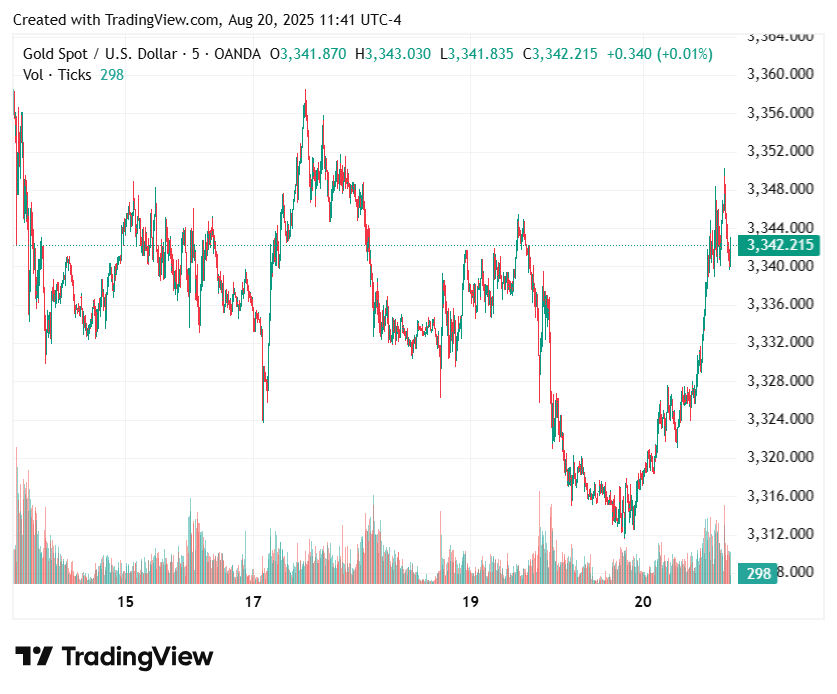
Spot gold advanced 0.8% to $3,341.56 per ounce by 11:40 a.m. ET to erase most of this week’s losses. US gold futures also gained 0.8%, trading at $3,385.20 an ounce in New York.

Gold surged above the $3,400 level earlier this month after the US central bank decided to hold interest rates steady in July, increasing the odds of a rate cut in September instead. Since then, the metal has gradually pulled back as mixed US economic data came out.

All eyes this week are on the Fed’s July meeting minutes, which are due later this afternoon, followed by Chair Jerome Powell’s speech at the annual Jackson Hole economic symposium on Friday.

“Gold prices fell yesterday, so now traders are looking at it as an opportunity to get into gold ahead of the Fed minutes,” RJO Futures market strategist Bob Haberkorn said in a note.

“If Powell is dovish, it’s bullish for gold, as it does not bear interest. It will need to break through $3,350/oz. and then ultimately retest $3,400/oz. if he’s dovish,” he added.

Traders currently expect an 85% chance of a quarter-point rate cut in September, according to the CME FedWatch tool.

Markets are also watching US efforts toward a landmark meeting between Russian President Vladimir Putin and his Ukrainian counterpart Volodymyr Zelenskiy. Any signs of a ceasefire could ease demand for gold.

Gold has climbed more than a quarter this year, as trade war fears and geopolitical tensions boosted its appeal as a safe asset, while central bank buying and inflows to exchange-traded funds also provided support.

Though it has traded in a relatively tight range since reaching a record at roughly $3,500 in April, banks like UBS and Citigroup expect further gains.


#174 - Dana White - CEO of the UFC